First Hot Air Balloon Ride in Napa Valley: What to Expect, Step by Step

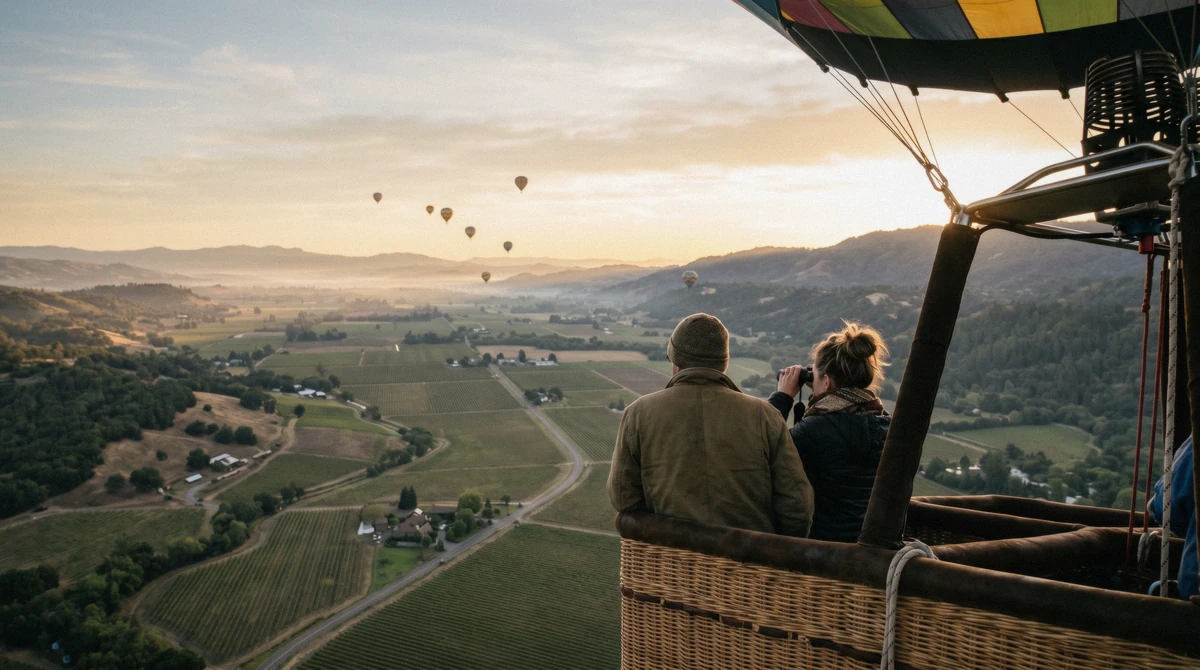
You don't need any ballooning experience, or even a head for heights, for your first hot air balloon ride in Napa Valley. The pilot handles the burner, the altitude, and the landing; you stand in the basket and watch the valley wake up. My own first flight I was nervous about the height once the ground fell away; within the first few minutes, watching the vineyards shrink into a patchwork below, that worry had turned into something closer to quiet. What follows is the exact morning, minute by minute, the nerves that turn out to be nothing, and which flight suits a total first-timer best.
Quick answer
No ballooning experience is needed for your first hot air balloon ride in Napa Valley. You don't need a head for heights or any prior skill; the pilot manages the burner, altitude, and landing while you simply stand in the basket and take in the view. Total time from check-in to landing runs 3 to 4 hours, with the flight itself lasting 45 to 60 minutes.
Key takeaways
- No prior experience or skill is required; the pilot handles every technical part of the flight
- Total time commitment is 3 to 4 hours door to door; actual airtime is 45 to 60 minutes
- The most common first-timer worry, the height, usually fades within the first few minutes once the ground has fallen away
- The most common beginner mistake is arriving underdressed for the 5:30 AM check-in, not the flight itself
- Once airborne there's no turning back early, the flight lands wherever the wind takes it, which is part of what makes ballooning different from a boat or a hike
- The small-group Yountville flight is the most straightforward first booking on this site
Do You Need Any Experience?
None. Hot air ballooning has no technique to learn beforehand: your pilot controls the burner and the altitude, ground crew handles inflation and packing away the envelope, and there is nothing to fit, adjust, or practice the way there is with, say, snorkel gear or a bicycle. You climb into the basket over roughly a four-foot wall, hold the rail during launch and landing, and otherwise stand and watch.
Guides brief every group at check-in regardless of experience level, so nobody is expected to arrive already knowing how any of it works.
How Fit Do You Need to Be?
The physical demands are genuinely modest. You'll stand for most of the flight, which runs 45 to 60 minutes, and you need to climb over a basket wall about four feet high to board and again to exit after landing, sometimes onto uneven vineyard ground rather than a paved lot. There's no walking, paddling, or sustained exertion once you're in the basket.
Good general health and the ability to climb into the basket unassisted are what operators actually ask for; there's no upper age limit. Anyone with a significant mobility impairment, a recent major surgery, or who is pregnant should check with the operator first rather than assume the flight is a fit; for the fuller list of who should sit this one out, see our guide on whether hot air ballooning in Napa Valley is safe.
What Happens on Your First Flight: Step by Step
Here's the chronology most first-timers actually experience, from booking to the drive back.
| Stage | How long | What happens |
|---|---|---|
| Booking and the night before | - | Confirmation arrives with a check-in time; lay out a warm layer and charge your phone |
| Arrival and check-in | 5:30 to 7:00 AM, about 20 to 30 minutes | Arrive at the launch field, coffee and snacks while the crew begins inflation around you |
| The briefing | 10 to 15 minutes | Pilot introduces themselves, covers boarding, hand positions, and the landing posture |
| The flight | 45 to 60 minutes | Sunrise launch, cruising at 1,000 to 3,000 feet, pilot commentary throughout |
| Landing and heading back | 30 to 60 minutes | Controlled landing, ground crew meets you, shuttle back for the toast or brunch |
Booking and the day before
A confirmation arrives with your check-in time, which shifts earlier in summer and later in winter, generally somewhere between 5:30 and 7:00 AM. There's little to prepare the night before beyond laying out a warm layer, since check-in is the coldest part of the entire morning, and charging your phone or camera battery.
Arrival and check-in
You'll meet the crew at the launch field, at V Marketplace in Yountville for the flagship flight, roughly 20 to 30 minutes before launch. Coffee and light snacks are typically waiting, and the crew begins unrolling and inflating the envelope right in front of you, worth arriving on time to watch rather than rushing in at the last minute.
The briefing
The pilot's safety briefing runs about 10 to 15 minutes and covers exactly what a first-timer needs: how to climb in and out of the basket, where to hold during launch and landing, and what to expect from the burner's noise and heat. This is also when the pilot answers questions, so anything you're nervous about is worth asking here rather than sitting with it silently.
The flight
Launch happens at sunrise, a smooth, quiet ascent with no jolt, and the flight cruises at 1,000 to 3,000 feet for 45 to 60 minutes. Wind determines the route, not the pilot, so no two flights follow exactly the same path, and you won't know exactly where you'll land until you're close to the ground.
Heading back
Landing is a controlled, gradual descent, and ground crew meets the basket wherever the wind has brought you, sometimes a marked field, sometimes a stretch of open vineyard. From there it's a shuttle back to the launch point for the champagne toast and brunch that follows most Napa Valley flights, then the rest of the morning is yours. Tipping the pilot and crew is discretionary but common practice, no fixed percentage, and it's usually handled as a group once everyone is back on the ground.
Your Morning, Hour by Hour
A closer look at the clock, using the flagship Yountville flight as the reference morning.
-
5:30 AM
Check-in at the launch field
Coffee and light snacks while the crew begins inflating the envelope around you
-
6:00 AM
Safety briefing and boarding
Pilot covers hand positions, boarding, and landing posture, about 10 to 15 minutes
-
6:30 AM
Sunrise launch
A smooth, quiet ascent with no jolt as the basket lifts off
-
6:30 to 7:30 AM
The flight
45 to 60 minutes cruising at 1,000 to 3,000 feet above the valley
-
7:30 AM
Landing
A controlled descent; ground crew meets you wherever the wind brings you down
-
8:00 to 8:30 AM
Champagne toast and brunch
Shuttle back to the launch point for the post-flight toast
-
~9:00 AM
Back at your hotel
3 to 4 hours door to door from check-in to being back where you started
What It Actually Feels Like
There's no technique to learn because there's nothing to operate. The burner fires in short bursts, loud enough to interrupt conversation for a second or two, then quiet returns and the only sound left is wind and the occasional dog barking somewhere below. There's no sensation of falling or swaying the way an amusement ride creates one, since the basket moves with the wind rather than against it, so the ride itself feels closer to standing still while the ground drifts beneath you than to any kind of motion you've felt before.
Temperature shifts fast once the burner cycles overhead, a wave of warmth for a few seconds, then it fades. Most first-timers stop narrating every detail out loud within the first ten minutes and just watch.
Preventing Motion Sickness on Your First Flight
This is one of the rare activities where motion sickness genuinely isn't much of a concern. A hot air balloon moves with the wind rather than against it or through choppy water, so there's no rocking, no engine vibration, and no relative motion between you and the air around you the way there is on a boat. If you're prone to motion sickness generally, a full night's sleep and a light breakfast rather than an empty stomach are still sensible precautions, but this is genuinely one of the smoothest ways to be airborne.
Nervous? What First-Timers Worry About (and What Actually Happens)
This is worth addressing directly rather than glossing over.
| Worry | The reality | What helps |
|---|---|---|
| The height, once the ground falls away | Most first-timers report the nerves fading within the first few minutes of launch | Focus on the horizon rather than straight down; the smooth, engine-free ascent helps more than expected |
| Panicking mid-flight with nowhere to go | There's no in-flight opt-out, the balloon lands wherever the wind takes it, on its own schedule | The pilot narrates constantly and can reposition you toward the center of the basket if you're uneasy |
| Feeling silly asking a basic question | Most passengers on a shared flight are first-timers themselves, and the briefing covers everyone equally | Ask during the briefing rather than sitting with it, the pilot has heard every question before |
| The burner noise | It fires in short bursts, loud for a second or two, then quiet returns | Most people stop noticing it entirely by the second or third cycle |
| Being unable to stop the flight if you change your mind | Backing out is easy and free before boarding; once airborne, the flight runs its planned length | Say so during the briefing if you have real doubts, before the balloon leaves the ground |
It's worth being direct about the difference between pausing and stopping for good. On a boat or a hiking trail, you can usually turn back early. A hot air balloon cannot pull over or set down early once it has launched, so the flight runs its full 45 to 60 minutes regardless of nerves; the only real opt-out window is before boarding, and it's free and judgment-free to use.
The Honest Pros and Cons of a First Flight
What we genuinely like
- No experience or fitness test required, the pilot handles every technical part
- The sunrise launch and the view over the vineyards deliver even on an ordinary flying morning
- Small-group flights mean real time with the pilot to ask questions
- The champagne toast and brunch afterward make the early start feel worthwhile
The honest downsides
- The 5:30 AM check-in is a genuinely early start, especially on a vacation
- Weather cancellations are common enough that a first flight isn't guaranteed to happen on your booked morning
- Once airborne, the flight runs its full length regardless of nerves, there's no early return
Who it's NOT for: Anyone who cannot stand unassisted for close to an hour,Children under the operator's height and age requirements,Anyone hoping to control exactly where the flight lands
Beginner Mistakes to Avoid
These are mistakes made during the flight itself. If you're still weighing whether the early start is worth it at all, our full breakdown of whether Napa Valley balloon rides are worth it covers the honest costs and payoffs; planning-stage mistakes like booking timing and season have their own answer in our Napa Valley hot air balloon mistakes guide.
- Wearing sandals or flip-flops to check-in, not permitted, and the one mistake that can keep you off the flight entirely
- Leaning over the basket rail for a photo instead of holding it as briefed
- Packing a heavy coat with nowhere to store it once the day warms up
- Expecting a guaranteed San Francisco skyline view, it's only visible on clear days with the right winds aloft
- Arriving late to check-in, which can delay inflation for the whole group
- Staying quiet during the briefing instead of asking questions, then feeling unsure once boarding starts
Etiquette on Your First Flight
A short list worth knowing before the burner fires for the first time.
- Keep voices low once the burner isn't firing, sound carries in open air and other passengers are often listening for the pilot's commentary
- Hold the rail during launch and landing rather than bracing on the basket wall itself
- Ask before leaning out for a photo, and let the pilot know if you want a particular angle
- No flash photography close to other passengers' faces in the low pre-dawn light
- Wait for the pilot's cue before moving to a different spot in the basket
- Keep loose items zipped away rather than balanced on the rail, a dropped item during flight is gone for good
Which Tours Are Best for First-Timers
Compare every hot air balloon ride in Napa Valley before you book your first flight; the flights below suit a total beginner best. Prices are current as of July 2026, last verified.
- Napa Valley: Hot Air Balloon Adventure, $288, small group capped at 9: the more personal introduction, with more of the pilot's attention and a thorough briefing before boarding. Launches from Yountville, the easiest meeting point to find on a nervous first morning.
- Wine Country Balloon Flight: Sonoma to Napa Valley, $325, roughly 4 hours: a larger operator with a Badge of Excellence track record and a champagne toast built into the price, a good fit for a first-timer who wants the full celebratory experience without arranging brunch separately afterward.
Expectations vs Reality
A short reality check before you go, since a few of these surprise nearly every first-timer.
| What first-timers expect | What usually happens |
|---|---|
| A gentle drift with constant movement | Long calm stretches at altitude, with the real motion mostly happening at launch and landing |
| A view of the San Francisco skyline every flight | Only visible on clear mornings with the right winds aloft, not guaranteed |
| A loud, jarring burner overhead the whole time | Short bursts of noise and heat, then quiet in between |
| Landing exactly back where you started | Landing wherever the wind has carried the balloon, sometimes a different field entirely |
| Feeling nervous the whole flight | Most first-timers report the nerves fading within the first few minutes of launch |
None of that makes the morning any less worth the early start, it just means the honest version looks a little different from the postcard.
What to Wear and Bring (the Short Version)
Dress in layers for the cold 5:30 AM check-in, a base layer under a jacket you can tie around your waist once the sun is up, plus long pants and closed-toe shoes; sandals and flip-flops aren't permitted. A hat and sunglasses matter more after landing than during the flight itself. Bring a phone or small camera with a strap, since both hands are useful during boarding, and a little cash for the pilot's gratuity if you'd like to tip.
For the full seasonal breakdown and packing list, see our guide to what to wear on a Napa Valley hot air balloon ride.
Camera or Phone: What Actually Works Here
A phone handles most of a Napa Valley flight fine, the basket is calm and dry, and the early light in the first twenty minutes photographs well on a recent phone camera. For anything beyond a wide shot, the distant Mayacamas ridgeline or Mount Saint Helena, a small mirrorless camera with a longer lens captures more than a phone will. Keep a spare battery in an inner jacket pocket rather than a bag, cold mornings drain batteries faster than expected.
There's no water risk in a basket, so skip anything built for underwater use, and be ready to hold your phone with a wrist strap rather than in an open hand near the rail during landing.
Frequently Asked Questions
How long does a first Napa Valley balloon ride actually take?
Total time from check-in to being back at your hotel runs 3 to 4 hours. The flight itself, from launch to landing, lasts 45 to 60 minutes; the rest is check-in, the briefing, and the post-flight toast.
Do I need any practice or experience before my first flight?
No practice is needed or expected. The pilot's briefing at check-in, about 10 to 15 minutes, covers everything a first-timer needs to know before boarding.
Can I back out if I get nervous once I'm at the launch field?
Yes, before boarding. Say so during the briefing and the crew will handle it without judgment. Once the balloon has left the ground, though, there's no early return, the flight runs its planned length and lands wherever the wind takes it.
Is there a minimum age for a first flight?
Yes, most Napa Valley operators require a minimum height around 48 inches and commonly a minimum age near 6, since children must be able to stand unassisted for the full flight. Our guide to hot air balloon rides in Napa Valley with kids covers the full age and height breakdown.
Should I tip the pilot?
It's discretionary, with no fixed percentage. Many groups tip the pilot and ground crew together at the end of the flight, once everyone is back on the ground.
How far ahead should I book my first Napa Valley balloon ride?
There's no strict rule, but keep the cancellation windows in mind (last verified July 2026): shared flights can be changed with 48 hours' notice, private charters need 10 days, so book with your travel flexibility in mind.
What should I wear on my first flight?
Warm, removable layers for the cold check-in, plus closed-toe shoes. See our full what to wear guide for the complete seasonal packing list.
Nothing about a first Napa Valley balloon ride requires prior experience, special fitness, or gear you don't already own. The one nerve nearly every first-timer names beforehand, the height, tends to fade within the first few minutes once the ground has fallen away and the valley starts waking up below. Start with the Napa Valley Aloft flight if a smaller group and a thorough briefing sound right for a first try.